Pool Plastering Plans: The Definitive Guide to Aquatic Finishes
The interior finish of a concrete swimming pool is its most vulnerable and essential component. While the structural shell provides the vessel’s shape and strength, the plaster serves as the primary waterproof barrier and the tactile interface for the user. It is a material subjected to an extraordinary set of environmental demands: constant immersion in chemically active water, varying hydrostatic pressure, and the abrasive effects of maintenance equipment. Consequently, the development of sophisticated pool plastering plans has moved from a simple trade craft to a specialized field of material science.
In the contemporary residential and commercial landscape, plastering is no longer viewed as a monolithic application of white cement and crushed marble. Instead, it is an engineered system designed to balance aesthetic clarity with chemical resilience. A successful project requires a deep understanding of cement hydration, aggregate density, and the Langelier Saturation Index (LSI). Without this technical grounding, a newly plastered surface—regardless of its initial beauty—will succumb prematurely to etching, scaling, or delamination.
For property owners and facility managers, the complexity of a renovation or new build lies in the coordination of timing and chemistry. The period immediately following the application of the plaster, known as the “start-up,” is more critical to the surface’s lifespan than the application itself. This article explores the systemic nature of aquatic finishes, providing a comprehensive framework for those seeking to master the nuances of interior pool renovation.
Understanding “pool plastering plans”
A “plan” in the context of pool plastering is often misinterpreted as a simple choice of color or texture. In professional editorial terms, high-level pool plastering plans represent a comprehensive technical specification that encompasses substrate preparation, material batching, atmospheric management during application, and a strictly governed hydration schedule. It is the roadmap that ensures the chemical bond between the new finish and the existing concrete shell remains permanent.
One of the most frequent oversimplifications in the industry is the assumption that any masonry crew can execute a submerged finish. Unlike a sidewalk or a driveway, pool plaster must cure underwater. This necessitates a specific ratio of water to cement (the w/c ratio) that minimizes porosity. If the plan does not account for the local source water’s mineral content, the plaster may “bleed” calcium during its first thirty days, leading to permanent discoloration known as mottling.
A definitive plan prioritizes three distinct phases:
-
The Mechanical Interface: Ensuring the “bond coat” provides sufficient tooth for the new plaster.
-
The Application Window: Managing the “cream” of the cement to prevent over-troweling, which weakens the surface.
-
The Saturation Strategy: A synchronized fill-and-balance protocol that prevents the water from “starving” for calcium and stripping it from the new walls.
Contextual Evolution of Aquatic Finishes
The history of pool plaster is a narrative of adaptation against chemical aggression. In the 1960s, “White Marcite”—a blend of white Portland cement and crushed marble—became the global standard. It was valued for its brilliant blue water reflection and smooth texture. However, as pool sanitation shifted toward higher chlorine concentrations and later, saltwater chlorine generators, the limitations of simple marble dust became evident. Marble is calcium carbonate, which is easily dissolved by acidic water.
By the 1990s, the industry saw the introduction of pozzolans and silica fumes. These additives densify the cement matrix, making it less permeable. This led to the “Aggregate Era,” where naturally rounded pebbles and colored quartz replaced marble dust. Modern pool plastering plans now frequently incorporate glass beads and polymer-modified cements, offering a surface that is essentially a non-porous ceramic shield. This evolution reflects a broader architectural trend: shifting from sacrificial surfaces that require frequent replacement to permanent finishes that function as part of the home’s structural legacy.
Conceptual Frameworks for Material Longevity
To evaluate a plastering strategy, one must employ specific mental models that go beyond cost-per-square-foot.
-
The LSI Buffer Model: This framework views the plaster not as a static object, but as a chemical participant. A plan must include an “LSI cushion,” where the start-up water is intentionally balanced to be slightly “scale-forming” to protect the new, soft plaster from aggressive leaching.
-
The Aggregate-to-Paste Ratio: The “paste” (cement and water) is the weakest part of the finish; the aggregate (stone/quartz) is the strongest. The most resilient plans maximize aggregate exposure and minimize the cement surface area.
-
Thermal Expansion Differential: Plaster and concrete have different expansion rates. A plan must account for the “thermal shock” that occurs if a pool is filled with icy well water on a 100-degree day, which can cause the finish to “pop” or delaminate.
Material Variations and Comparative Trade-offs
The selection of material defines the maintenance profile of the pool for the next two decades.
| Material Category | Primary Components | Expected Lifespan | Aesthetic Profile |
| Standard Marcite | White Cement/Marble | 5–8 Years | Bright White/Classic |
| Quartz Aggregate | Ceramic Coated Silica | 10–12 Years | Speckled/Vibrant |
| Pebble Finish | Natural River Stones | 15–25 Years | Organic/Textured |
| Polished Pebble | Machine-Honed Stone | 15–20 Years | Smooth/Luxury |
| Pozzolan-Modified | Cement w/ Additives | 8–10 Years | Smooth/Durable |
Decision Logic
For a high-use commercial facility, a Pebble Finish is often the only logical choice due to its resistance to the heavy chemical dosing required by health codes. In contrast, for a luxury residential spa where skin comfort is the priority, a Polished Pebble or Quartz plan provides the necessary smoothness without the fragility of traditional marcite.
Operational Scenarios and Environmental Constraints Pool Plastering Plans
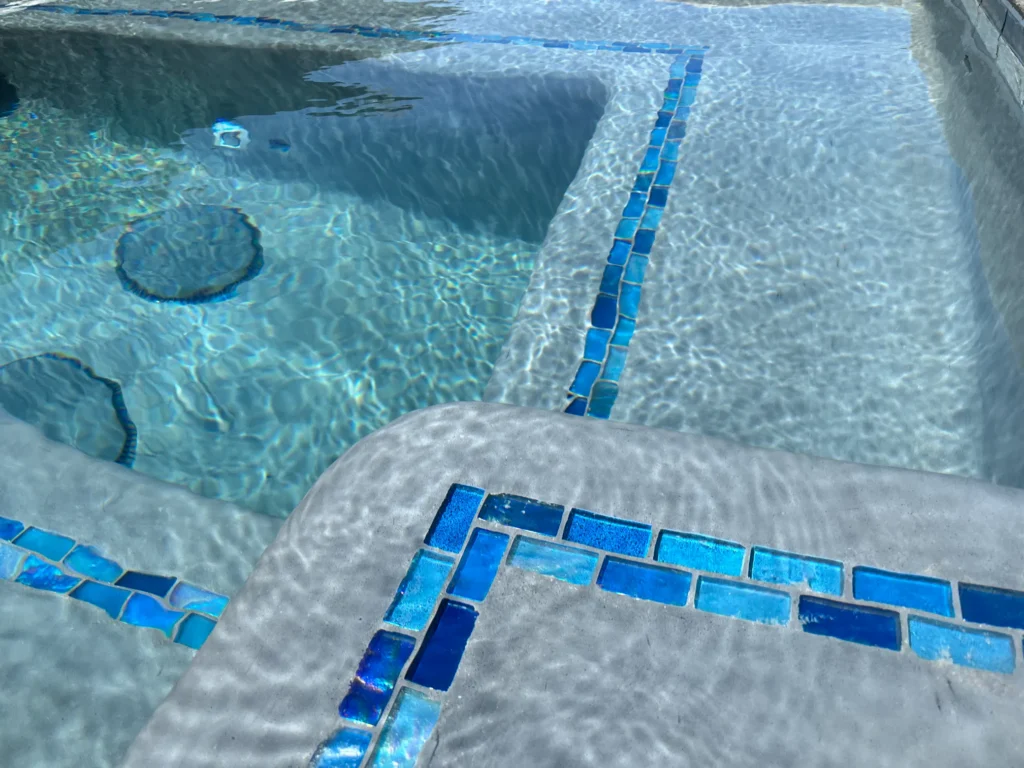
Scenario A: The Saltwater Environment
Saltwater pools are essentially chlorine-producing factories. The electrolysis process can be harsh on soft masonry. A plan for a saltwater pool must prioritize high-density aggregates and avoid marble dust entirely, as the salt environment accelerates the “pitting” of soft calcium.
Scenario B: The High-TDS (Total Dissolved Solids) Region
In areas with “hard” water, the source water used to fill the pool is already saturated with minerals. This creates a risk of immediate scaling on new plaster. Here, the plan must include sequestering agents—chemicals that “lock up” minerals—to prevent them from “crusting” onto the new finish before it has fully cured.
Resource Dynamics and Lifecycle Economics
The true cost of plastering is rarely found in the material invoice; it is found in the “Total Cost of Ownership” (TCO).
| Expense Category | Direct Cost | Indirect Impact |
| Prep/Stripping | Moderate | Ensures bond longevity |
| Material Upgrade | High | Extends replacement cycle by 10+ years |
| Start-up Chemistry | Low | Critical to 90% of surface health |
| Water Trucking | Variable | Prevents “fill lines” and heat checking |
Opportunity Cost Analysis: Choosing a standard plaster over a pebble finish might save $3,000 today, but if the standard plaster fails in 7 years versus the pebble’s 20, the homeowner is essentially paying a 300% premium for the cheaper option when labor and inflation are factored into the next renovation cycle.
The Taxonomy of Failure: Risk and Mitigation
Professional pool plastering plans are essentially risk-mitigation documents. The most common failures are avoidable through strict governance:
-
Check-Cracking: Caused by the plaster drying out too fast before the pool is filled. Mitigation: Constant misting of the shell.
-
Calcium Nodules: Small white “volcanoes” caused by water weeping through the shell and pushing calcium out. Mitigation: Proper structural waterproofing before plastering.
-
Shadowing: Dark streaks in colored plaster caused by calcium chloride accelerators. Mitigation: Banning the use of “hot” additives in the mix.
Governance, Maintenance, and Long-Term Adaptation
Once the plaster is applied, it enters a “living” phase. A maintenance checklist for new plaster should be layered by time:
-
Day 1–30 (The Hydration Phase): Brush the pool twice daily to remove “plaster dust” (calcium carbonate). Do not use a robotic cleaner, as its wheels can leave tracks in the soft surface.
-
Month 1–6 (The Stabilization Phase): Maintain LSI between 0.0 and +0.3. This “slightly scale-forming” water allows the plaster to achieve maximum density.
-
Year 1+ (The Mature Phase): Monitor for “etching” (roughness). If the surface feels like sandpaper, the water has become aggressive and is “eating” the cement.
Critical Misconceptions and Industry Myths
-
“Dark plaster makes the water warmer.” While technically true, the difference is often less than 2 degrees. The real trade-off is that dark plaster shows every minor chemical mistake (bleaching/scaling).
-
“You can just plaster over old plaster.” This is a high-risk maneuver. Without “chipping out” the old surface, the new layer is prone to “hollows” and debonding.
-
“The plaster is the leak-proof layer.” Plaster is water-resistant, but it is not a structural membrane. If the concrete shell is cracked, new plaster will eventually crack in the same spot.
Conclusion
The successful execution of pool plastering plans is a testament to the intersection of manual craftsmanship and chemical precision. It is a process where the stakes are high; a mistake in the first twenty-four hours can result in a decade of aesthetic regret. By moving beyond a “finish-only” mindset and embracing a systemic approach that includes substrate integrity, atmospheric control, and rigorous start-up chemistry, property owners can ensure that their aquatic investment remains both structurally sound and visually compelling. The ultimate goal is a surface that does not merely contain water, but enhances the very experience of the environment.